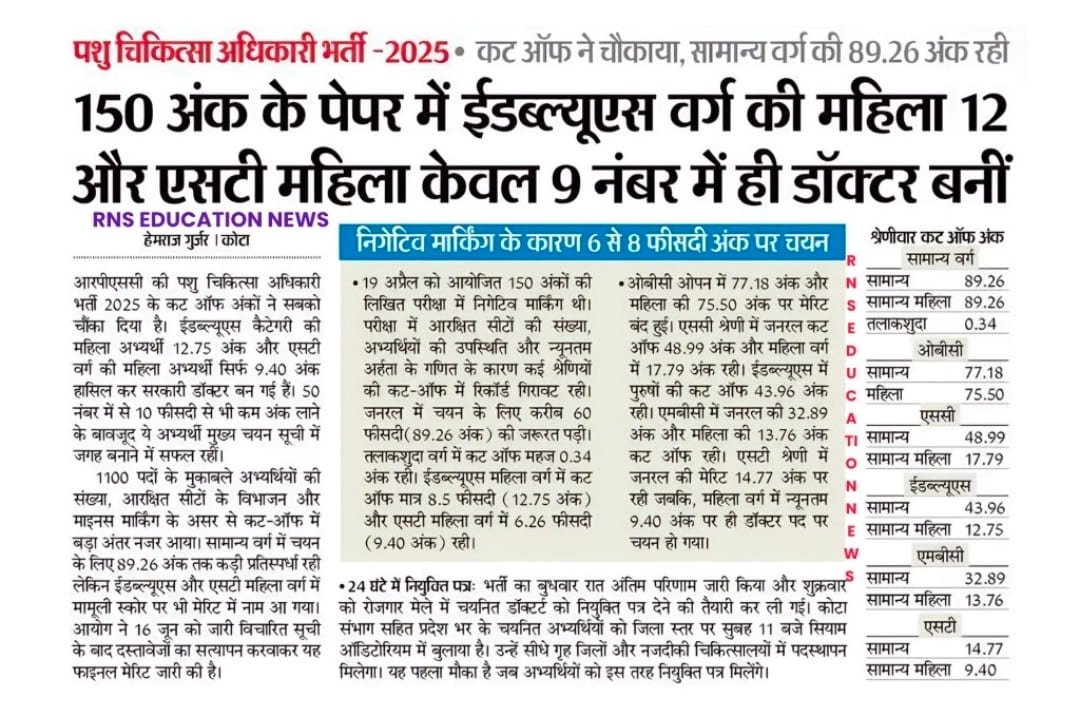
An examination of 150 marks.
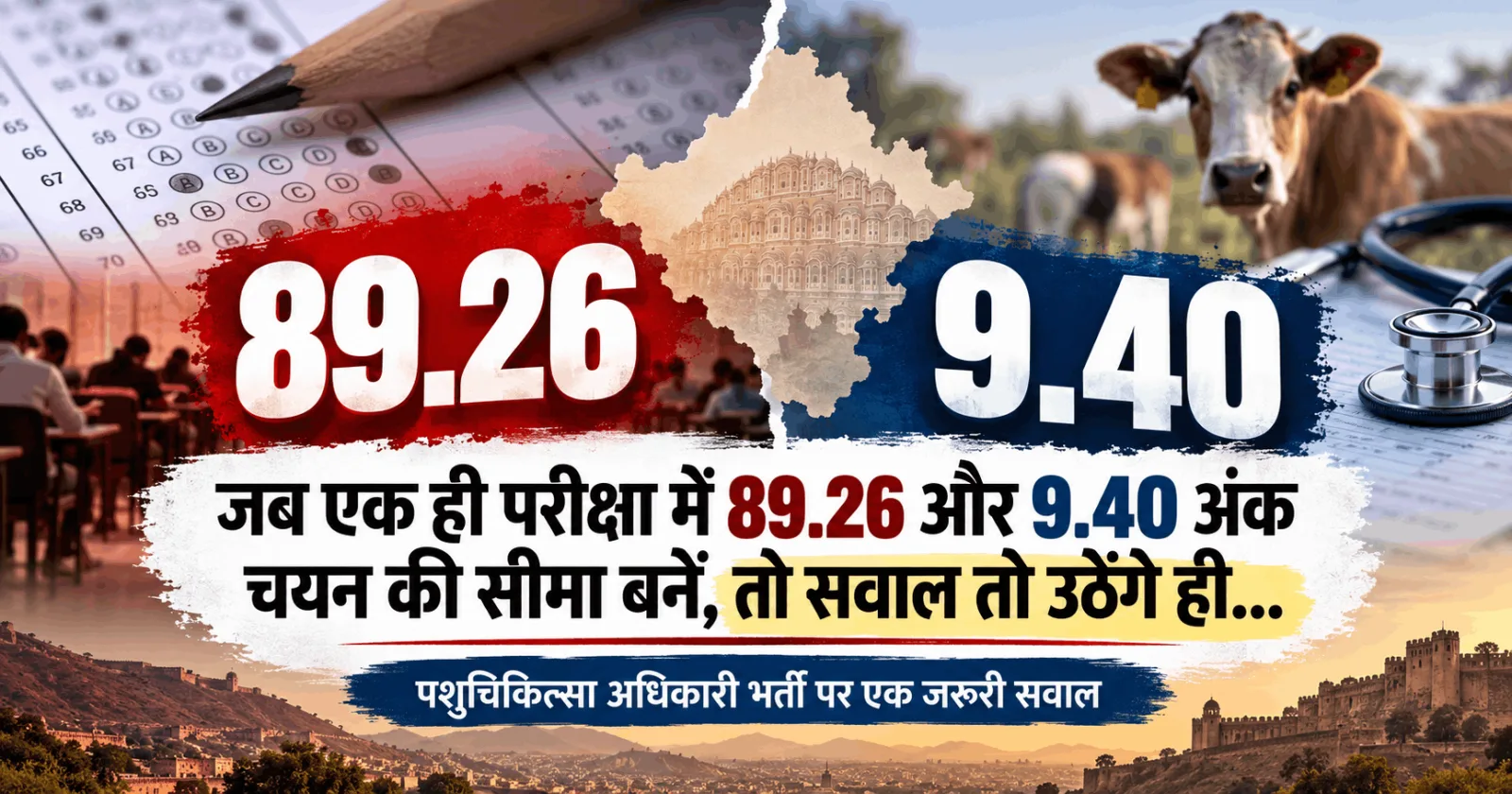
The cut-off for the General category — 89.26 marks.
And the cut-off for the Scheduled Tribe Women category — 9.40 marks.
That means around 60 percent on one side and around 6 percent on the other.
When we look at these figures, the first thought is not against any caste or any selected candidate.
The first question that comes to mind is—
Is there something in our system that society needs to reconsider calmly and seriously?
Imagine the home of a student.
He spends years studying veterinary science.
His family pays the fees.
They buy books.
They spend money on hostel accommodation, travel, examinations and preparation.
Even after completing the degree, the struggle does not end.
Preparation for a government job begins again.
Months pass.
Perhaps years.
The family continues to hope—
“Our child is working hard. If he scores well, he will surely get a job.”
Then the result arrives.
He scores very well, but falls a few marks short of the cut-off in his own category.
And in the same result, he sees that the cut-off in another category has gone many times lower.
What must be going through that young person’s mind at that moment?
What would his mother be thinking?
What would his father feel after spending years of earnings on his education?
Would it be wrong for them to ask—
“What was our child’s fault?”
He did not choose where he was born.
He did not choose his family.
He did not choose his caste.
Birth is not in anyone’s control.
Then should an identity received at birth influence a person’s opportunities to such a great extent?
This question is not against any section of society.
It is a question for the system.
It Would Be Wrong to Blame the Selected Candidate
This must also be made equally clear.
A candidate who scored 9.40 marks did not become a veterinarian on the basis of those 9.40 marks.
The candidate had already completed the prescribed veterinary education and degree before appearing in this recruitment examination.
The candidate did not make the rules.
The candidate simply accepted the opportunity provided by the existing system.
Therefore, it would not be fair to insult any selected candidate or to label someone an “incompetent doctor” merely on the basis of marks obtained in the recruitment examination.
But that does not mean society should stop questioning the system.
In fact, the real question begins here—
If the Purpose of a Competitive Examination Is to Select Competent Veterinary Officers, Why Should There Not Be a Common Minimum Qualifying Standard?
Let reservation continue.
Let reserved posts remain.
Let representation of disadvantaged sections be ensured.
But should there not be a common minimum competency threshold that every candidate must cross?
Reservation could then be applied among those who cross that threshold.
Can social justice and minimum professional competence not exist together?
Now Think About the Livestock Farmer...
Imagine a family in a small village of Rajasthan whose cow suddenly becomes seriously ill.
That cow provides milk for the household.
Perhaps the family’s livelihood depends on that income.
Perhaps the children’s school fees are paid from the earnings of that animal.
The livestock farmer works day and night.
He pays taxes.
He participates in the democratic process and votes.
All he expects from the government is that when his animal falls ill, he receives quality veterinary care at the government hospital.
Is that demand unreasonable?
What is the fault of that livestock farmer if the officer posted in his area comes through one category or another?
An animal does not ask which caste the doctor belongs to.
It only needs the person standing in front of it to understand the illness correctly and provide the right treatment.
So the question is—
Should the minimum quality of government veterinary services not be the same across the entire state?
Then Why Have a Competitive Examination at All?
This is another serious question.
If obtaining a veterinary degree itself is sufficient proof that every candidate is equally fit for government service, then why conduct a separate competitive examination?
And if the examination is conducted to distinguish candidates on the basis of knowledge, preparation and ability, then how much importance should examination marks carry?
On one hand, we tell young people—
Study.
Work hard.
Compete.
Score well.
On the other hand, when the result is declared and such a wide difference appears between category-wise cut-offs, it is natural for a young person to ask—
“Where does the value of hard work end, and where does the role of birth begin?”
This question may make us uncomfortable.
But suppressing a question merely because it is uncomfortable cannot be the solution.
Social Justice Is Necessary — But What Should Its Form Be?
It is also true that there have been families and communities in our society that, for long periods, did not have equal access to education, resources and opportunities.
Helping them move forward is the responsibility of both society and the government.
If a child cannot afford fees—
The government should pay the fees.
If a child does not have books—
Provide the books.
Provide scholarships.
Provide hostel facilities.
Provide food support.
Provide free preparation for competitive examinations.
Provide good teachers.
Provide additional training.
If a child is starting the race far behind others, the government should hold that child’s hand and help bring them to the starting line.
But when the same person is going to serve as a doctor, veterinarian, teacher, engineer or in another responsible professional position, should the minimum competency line not be the same for everyone?
That is the question that deserves serious consideration.
The Example of the Armed Forces Also Makes Us Think
India’s Armed Forces do not follow the same caste-based reservation system that is seen in many general government recruitments.
Why?
Because national security, operational capability and defined standards are given extremely high importance there.
Of course, military service and medical service are not the same.
But the comparison still raises an important question—
If a certain minimum level of capability is considered essential for national security, why should there not be a common minimum standard in fields connected with life and health?
A wrong medical decision can affect a human life.
A wrong veterinary decision can affect not only an animal’s life but also the livelihood of the livestock owner.
Poor quality in education can affect not just one child, but an entire future generation.
So should society not have the right to demand a common minimum level of competence in such fields?
And We Must Also Listen to the Student’s Side...
We often discuss reservation in terms of statistics and laws.
But behind those figures are human beings.
Imagine the young person who prepared sincerely.
From childhood, he was taught—
“Work hard and you will move ahead.”
But when the result comes and he sees that a category determined by birth has created a very wide difference in opportunities, is it unnatural for him to feel disappointed?
Will this reduce social distance?
Will it weaken caste identities?
Or is it possible that, while trying to reduce caste divisions, our systems repeatedly remind young people of their caste identity?
This is also a question society should ask itself.
Perhaps the Debate Needs to Move Beyond “Reservation or No Reservation”
The solution may lie somewhere between two extremes.
Social justice should not be abandoned.
Merit should not be abandoned.
Representation of disadvantaged groups should not disappear.
And no other young person should feel that the value of his or her hard work has been reduced because of birth.
So can we create a system in which—
Disadvantaged candidates receive strong educational and preparatory support.
Reserved representation continues.
But a common minimum qualifying standard becomes compulsory for every candidate in responsible technical services.
And reservation rules are then applied among candidates who cross that common minimum standard.
Could this create a better balance between social justice and merit?
This Is Not About the Victory or Defeat of Any Caste
The real issue is—
The confidence of the student who works hard for years.
The confidence of the family that invests its earnings in a child’s education.
The right of the livestock farmer who expects quality veterinary care.
The life of the animal that cannot speak for itself.
And ultimately, the issue is our trust in a system that is expected to assure us that hard work, social justice and public interest can move forward together.
So the question is very simple—
Should medical, veterinary, educational and other responsible technical services have a common minimum qualifying standard for all categories, with reservation being applied above that threshold?
This question is not against any selected candidate or any community.
It is a question being asked of our system.
What do you think?
Please share your opinion.
Reasoned disagreement is welcome, but no insulting language against any caste, community or individual. Let the discussion remain focused on the system—not on people.