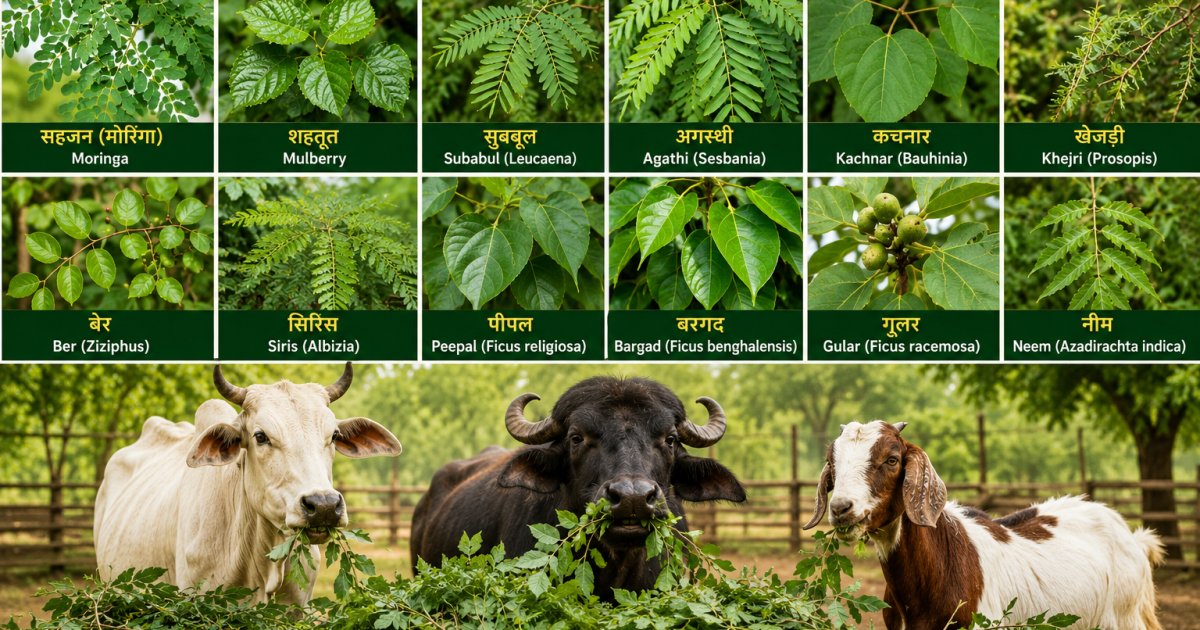
<h2>Tree Leaves in the Feed of Cows, Buffaloes and Goats: Which Leaves Are Useful and Why?</h2>
<p>In India, livestock farming has never depended only on concentrate feed and green fodder grown in fields. In villages, tree leaves have been used for centuries as an important source of animal feed. Especially during summer, drought, fodder shortage, low-rainfall conditions and for small livestock farmers, tree leaves become a major support. In animal husbandry, these are commonly known as <strong>tree fodder</strong> or <strong>top feed</strong>.</p>
<p>Tree leaves can be useful for cows, buffaloes and goats, but every leaf is not equally suitable for every animal. Goats are naturally browsing animals, so they consume tree leaves, shrubs and creepers more easily. For cows and buffaloes, tree leaves are safer and more practical when used as <strong>supplementary fodder</strong> rather than as the main feed.</p>
<h2>Why Are Tree Leaves Useful for Livestock?</h2>
<p>Tree leaves are not merely stomach-filling fodder. Many tree leaves contain good levels of protein, minerals, vitamins and digestible nutrients. When an animal is getting only dry straw, crop residues or low-quality fodder, such leaves can help improve the quality of the diet.</p>
<p><strong>Their main benefits are:</strong></p>
<p><strong>1. Protein support:</strong> Protein deficiency is a common problem in dry fodder. Leaves of moringa, mulberry, subabul, agathi and kachnar can be good sources of protein.</p>
<p><strong>2. Minerals and vitamins:</strong> Tree leaves may provide calcium, magnesium, trace minerals and carotene, which support milk production, growth, reproduction and general health.</p>
<p><strong>3. Fodder support during dry periods:</strong> When green fodder is not available in fields, tree leaves become a useful option for livestock farmers. This is especially important in semi-arid regions such as Rajasthan.</p>
<p><strong>4. Special importance in goat farming:</strong> Goats naturally prefer eating leaves of trees and shrubs. Therefore, tree fodder plays a very important role in goat farming.</p>
<h2>Major Useful Fodder Trees for Cows, Buffaloes and Goats</h2>
<h2>1. Moringa / Drumstick Tree</h2>
<p>Moringa leaves are considered highly nutritious for animals. They contain good amounts of protein, minerals and vitamins. Moringa leaves can be useful for cows, buffaloes and goats.</p>
<p>The biggest advantage of moringa is that it grows quickly and produces new leaves even after repeated cutting. It can be planted on field boundaries, vacant spaces or in fodder plots. In milch animals, it should be introduced gradually into the diet.</p>
<p><strong>Why useful:</strong> Good protein content, good digestibility and good growth ability in warm regions.</p>
<h2>2. Mulberry</h2>
<p>Mulberry leaves are palatable, soft and digestible. Cows, buffaloes and goats can all consume them. In areas where water is available, mulberry can be developed as a fodder tree.</p>
<p>Mulberry leaves can serve as good-quality green fodder for goats and milch animals. It is especially useful for farmers who want to produce more nutritious fodder in a small area.</p>
<p><strong>Why useful:</strong> Palatable, protein-rich, highly digestible and suitable for milch animals.</p>
<h2>3. Subabul / Leucaena</h2>
<p>Subabul is a drought-tolerant tree and its leaves are rich in protein. It can be useful for goats, sheep and, in limited quantities, cows and buffaloes. However, the biggest precaution with subabul is that it contains <strong>mimosine</strong>, a compound that can be harmful when consumed in excess.</p>
<p>Subabul should never be given alone as the main feed. It should always be mixed with other leaves, grasses or dry fodder and fed in limited quantities.</p>
<p><strong>Why useful:</strong> High protein, drought tolerant and suitable for low-water areas.</p>
<p><strong>Precaution:</strong> Feeding in excess may cause hair loss, weakness, digestive problems or reduced production.</p>
<h2>4. Agathi / Sesbania grandiflora</h2>
<p>Agathi leaves are soft and nutritious. This tree grows fast and its leaves are considered useful for goats and cows. Small farmers can plant it on field boundaries or around the house.</p>
<p>Agathi should not be introduced suddenly in large quantities. Animals should be adapted to it gradually.</p>
<p><strong>Why useful:</strong> Soft leaves, good protein and fast-growing fodder tree.</p>
<h2>5. Kachnar / Bauhinia</h2>
<p>Kachnar leaves are especially liked by goats. This tree can provide useful leaf fodder even during dry periods. Cows can also be fed its leaves in limited quantities.</p>
<p>Kachnar is easily available in rural areas and can be planted for fodder, shade and environmental benefits.</p>
<p><strong>Why useful:</strong> Good browse for goats, helpful during dry seasons and locally available.</p>
<h2>6. Khejri</h2>
<p>Khejri has special importance in Rajasthan and other dry regions. Its leaves, known in many areas as <strong>loong</strong>, are traditionally used as livestock feed. Khejri is considered a very useful fodder tree for cows, buffaloes, goats, sheep and camels.</p>
<p>The special feature of khejri is that it survives with very little water and also helps improve soil fertility. In Rajasthan’s livestock system, khejri is not just a tree but a strong foundation of animal feed security.</p>
<p><strong>Why useful:</strong> Drought tolerant, local fodder source and traditionally safe for use.</p>
<h2>7. Ber Leaves</h2>
<p>Ber leaves are especially useful for goats, sheep and camels. Ber is easily available in dry regions and goats eat it readily. Cows and buffaloes can also be given ber leaves in limited quantities, but care should be taken regarding thorns and hard twigs.</p>
<p><strong>Why useful:</strong> Available in dry areas, good browse for goats and grows with low maintenance.</p>
<h2>8. Siris / Albizia</h2>
<p>Siris leaves are also used as top feed. They can be useful for goats and sheep. In cows and buffaloes, acceptance depends on the animal’s taste and feeding habit.</p>
<p><strong>Why useful:</strong> Protein-rich leaf fodder, along with shade and environmental benefits.</p>
<h2>9. Shisham</h2>
<p>Shisham leaves can be fed to animals in limited quantities. It is not suitable as a main fodder, but it can be used in mixed leaves during fodder shortage.</p>
<p><strong>Why useful:</strong> Supplementary leaf fodder based on availability.</p>
<h2>10. Peepal, Banyan, Gular and Pakar</h2>
<p>The leaves of these trees have traditionally been fed to animals during crisis or fodder shortage. Goats consume them more easily. Cows and buffaloes should be given these leaves in limited quantities and mixed with other fodder.</p>
<p><strong>Why useful:</strong> Available in rural areas, useful for goats and helpful as emergency fodder.</p>
<h2>11. Neem</h2>
<p>Neem leaves have medicinal properties, but they should not be fed in large quantities like regular green fodder. Neem is bitter and contains bioactive compounds. Therefore, it should be given only in very limited quantities.</p>
<p><strong>Why useful:</strong> Medicinal value in limited quantity.</p>
<p><strong>Precaution:</strong> Excess feeding should be avoided in pregnant, weak or young animals.</p>
<h2>Which Leaves Are More Suitable for Which Animal?</h2>
<p><strong>Cow:</strong> Moringa, mulberry, khejri, kachnar, limited subabul, agathi and siris leaves can be useful. In cows, leaves should always be introduced gradually and mixed with dry fodder or green fodder.</p>
<p><strong>Buffalo:</strong> Buffaloes generally prefer soft and palatable fodder. Mulberry, moringa, khejri and limited quantities of other leaves can be given. In buffaloes, suddenly feeding a large quantity of new leaves may reduce intake.</p>
<p><strong>Goat:</strong> Tree leaves are extremely useful for goats. Kachnar, ber, khejri, mulberry, moringa, subabul, siris, peepal, banyan and gular leaves can be consumed well by goats. However, even goats should not be kept continuously on only one type of leaf in large quantity.</p>
<h2>How Should Tree Leaves Be Fed?</h2>
<p>The correct method of feeding tree leaves is very important. If leaves are not given properly, the animal may eat less or may develop digestive problems.</p>
<p><strong>1. Start gradually:</strong> Any new leaf should first be given in small quantity. Increase the quantity gradually over 5 to 7 days.</p>
<p><strong>2. Feed as a mixture:</strong> Instead of feeding leaves of only one tree, a mixture of 3 to 4 types of leaves is better. This improves nutritional balance and reduces the risk of harmful effects from any one type of leaf.</p>
<p><strong>3. Wilt slightly before feeding:</strong> Some leaves may be less palatable when fresh. Wilting them in shade for 2 to 4 hours can make animals eat them more easily.</p>
<p><strong>4. Mix with dry fodder:</strong> Mixing leaves with straw, crop residues or dry fodder helps make the diet more balanced.</p>
<p><strong>5. Provide mineral mixture:</strong> Leaves are useful, but for proper mineral balance, mineral mixture and clean drinking water are essential.</p>
<h2>How Much Quantity Should Be Given?</h2>
<p>In cows and buffaloes, tree leaves should not become the main part of the total diet. Generally, they should be used as <strong>supplementary fodder</strong>. In milch animals, feeding tree leaves up to about 10 to 20 percent of the total green fodder can be considered practical.</p>
<p>In goats, the proportion of tree leaves can be higher because goats are naturally browsing animals. Even then, goats should not depend only on one type of tree leaf. They should receive a balanced diet with dry fodder, green fodder, concentrate feed, mineral mixture and clean water.</p>
<h2>Precautions: Which Mistakes Should Be Avoided?</h2>
<p><strong>1. Do not feed too much of one type of leaf:</strong> Subabul, neem, shisham or leaves containing high tannins may be harmful in excess.</p>
<p><strong>2. Do not feed pesticide-sprayed leaves:</strong> Leaves should not be fed to animals after pesticide spraying in fields or orchards.</p>
<p><strong>3. Avoid dusty and polluted roadside leaves:</strong> Pollution, dust and chemicals may affect animal health.</p>
<p><strong>4. Do not feed mouldy or rotten leaves:</strong> Such leaves may cause digestive problems, toxicity and reduced milk production.</p>
<p><strong>5. Do not introduce large quantities suddenly:</strong> Sudden feeding of a new leaf in large quantity may reduce feed intake or cause diarrhoea/bloat-like problems.</p>
<p><strong>6. Be careful in pregnant and sick animals:</strong> For pregnant, weak, young or sick animals, any new leaf should preferably be introduced after consulting a veterinarian or experienced livestock expert.</p>
<h2>Useful Fodder Trees for Rajasthan and Dry Regions</h2>
<p>In regions like Rajasthan, tree leaves should be part of the livestock feed security system. Priority should be given to trees that can grow with less water and provide useful fodder for animals.</p>
<p><strong>Important fodder trees for Rajasthan:</strong></p>
<p><strong>1. Khejri:</strong> A local and highly useful fodder tree.</p>
<p><strong>2. Moringa:</strong> Nutritious and fast-growing tree.</p>
<p><strong>3. Mulberry:</strong> A very good option where water is available.</p>
<p><strong>4. Ber:</strong> Good browse for goats and sheep.</p>
<p><strong>5. Kachnar:</strong> Useful for goats and mixed fodder.</p>
<p><strong>6. Subabul:</strong> In limited quantity, mixed with other leaves.</p>
<p><strong>7. Siris and Shisham:</strong> Supplementary leaf fodder as per availability.</p>
<h2>A Good Mixed Leaf Fodder Model</h2>
<p>If livestock farmers want to plant fodder trees around their fields or animal sheds, they should not plant only one type of tree. A mixed model is better for varied nutrition and seasonal availability.</p>
<p><strong>A useful mixture:</strong></p>
<p>Khejri + Moringa + Mulberry + Kachnar + Ber + Limited Subabul</p>
<p>Such mixed fodder trees can provide strong support to livestock farmers during summer, drought and fodder shortage. Along with this, these trees also contribute to shade, soil conservation, environmental improvement and biodiversity.</p>
<h2>Conclusion</h2>
<p>Tree leaves can be very useful in the feeding of cows, buffaloes and goats, but they should be used wisely. Trees such as moringa, mulberry, khejri, kachnar, ber, agathi and subabul in limited quantity are important fodder sources for livestock farming.</p>
<p>The safest rule is to consider tree leaves as <strong>supplementary fodder</strong>, not the main diet. Instead of feeding one type of leaf in excess, provide a mixture of different leaves. Leaves should be clean, safe, pesticide-free and fed in proper quantities.</p>
<p>For small livestock farmers, goat farmers and drought-affected regions, tree leaves are not merely a fodder source but an important foundation of <strong>animal feed security</strong>. By planting the right trees and using them correctly, farmers can improve milk production, animal health and fodder availability.</p>
<p><em>Note: This article is for general information and awareness of livestock farmers. In case of any specific disease, toxicity, pregnancy, sudden decrease in milk production or dietary change, consult the nearest veterinarian or livestock expert.</em></p>
<h2>Author Introduction</h2>
<p><strong>Dr. Mukesh Swami</strong> is an experienced veterinarian with practical expertise in livestock health and animal husbandry. After retirement, he has been working to share useful and easy-to-understand information with livestock farmers, rural communities and animal keepers on animal health, nutrition, disease control and practical livestock management.</p>
<p>Through <strong>Pashupalan.co.in</strong>, he aims to provide farmers with scientific knowledge, field-based experience and practical guidance suited to local conditions.</p>