Water Crisis 2026 and Animal Husbandry: Shortage of drinking water for livestock, declining water quality, and solutions.
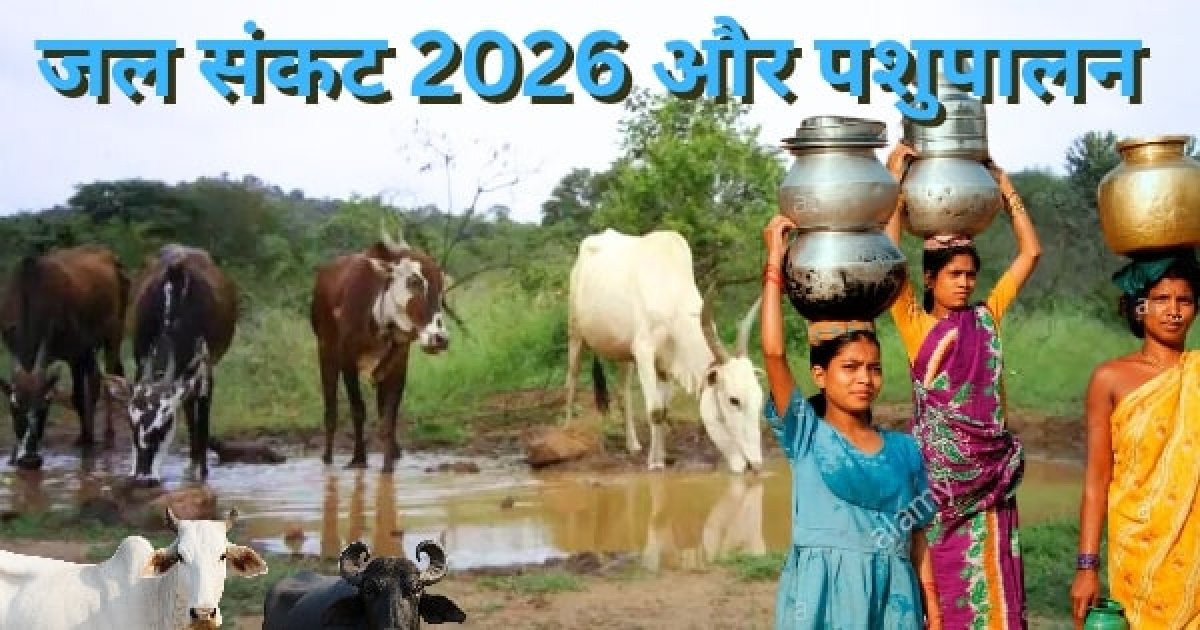

Water Crisis 2026: Impact on Livestock
How will the growing water crisis in 2026 affect livestock farming in villages? A detailed analysis of the impact on water availability, health, milk production, grazing, and potential solutions for cows, buffaloes, and goats.
Livestock farming has always been a primary source of livelihood in rural India. However, the projected "water crisis" for 2026 poses a serious challenge to the livestock sector. Animals like cows, buffaloes, goats, sheep, and camels require sufficient and clean water daily, but dwindling groundwater levels and drying ponds are making it increasingly difficult to meet this need.
In this blog, we will understand how the 2026 water crisis will affect livestock farming, what the risks are, and what solutions livestock farmers can adopt to tackle this problem.
1. Water for Livestock – How Important Is It?
Daily water requirement for most animals:
- Cow/Buffalo: 40–60 liters
- Goat/Sheep: 3–7 liters
- Camel: 30–40 liters
- Milking Buffalo: Up to 70–80 liters depending on milk production
This water is essential not only for drinking but also for digestion, regulating body temperature, and maintaining milk production. Water scarcity or poor water quality immediately affects the animal's health.
2. Water Crisis 2026 – Potential Impact on Livestock Farming
In rural areas, many ponds, reservoirs, streams, and check dams dry up within a few months after the rainy season.
This has a profound impact on animal husbandry: * Severe shortage of fodder and water * Dehydration in animals * 20–40% drop in milk production * Significant increase in heat stress cases * Mineral imbalance and weakness in animals * Lower SNF and fat content in milk When ponds dry up, livestock farmers have to fetch water from borewells or distant handpumps—this increases both labor and costs.3. Declining Water Quality – Another Major Threat
When water levels drop, the concentration of several harmful elements in groundwater increases, such as: * Fluoride * Nitrate * Arsenic * Hardness Drinking such water leads to several diseases in animals: * Weakening of legs and joints * Dental problems * Digestive problems * Problems with conception * Stunted growth in calves4. Increased Pressure on Grazing Lands and Forests
Water scarcity also affects grazing lands. Where grass was previously available for 8–10 months, it is now barely available for 3–4 months. This results in: * Animals having to be taken long distances for grazing * Reduced milk production due to increased energy expenditure * Increased labor and costs for herders * Increased conflict over water between wildlife and livestock5. Practical Solutions for Livestock Farmers
5.1. Water Storage System
If water is available in your village during the rainy season, storing it is the best solution.
- Small ponds or 10x10 or 20x20 pits in the fields (Farm Ponds)
- Polysheet lining in unlined ponds
- PVC tanks / Cement tanks
- Borewell recharge pit
5.2. Shaded Water Troughs for Animals
Animals should always be given water in the shade. This keeps the water cool and increases water intake.
5.3. Rejuvenation of Water Sources at the Village Level
- Desilting of ponds
- Reconstruction of village ponds
- Small check dams to retain water in streams
- Filling small ponds by collecting rainwater
5.4. Mineral Supplements for Animals
To reduce the effects of poor water quality:
- Mineral mixture + Vitamin A, D, E
- Electrolytes
- Toxin Binder in water (where necessary)
5.5. Water Quality Testing
Livestock farmers should get their water tested at least once a year:
- TDS
- Fluoride
- Nitrate
- Hardness
This helps you in planning the correct treatment and supplement program.
6. Rainwater Harvesting – The Future of Animal Husbandry
Rainwater harvesting is the biggest solution to the water crisis of 2026. If even 20-30% of the village's rainwater seeps into the ground, borewells in many areas can be recharged.
Farm ponds + trees + check dams = considered a successful model for rural water solutions.
7. NGOs, Panchayats, Government, and Livestock Farmers – The Combined Role of All Four
Water conservation is only successful when the community works together. Shristimitraa and other organizations are working in villages on awareness campaigns, plantation drives, and the rejuvenation of water sources.
By the Government:
- Excavation of ponds under MGNREGA
- Jal Jeevan Mission
- PMKSY
These schemes will only be effective when livestock farmers, villagers, and the Panchayat work together to implement them.
Conclusion
The water crisis could become the biggest challenge for livestock farming by 2026, but through community efforts, rainwater harvesting, rejuvenation of water sources, and maintaining nutritional balance in animals, this problem can be largely solved.
If every livestock farmer, at their own level, digs a small pond, provides a shaded water trough, and plants 5-10 trees, the water crisis in the entire village can be significantly reduced.